


Stanley Druckenmiller doesn't often write op-eds, but when he does, it marks a moment where he believes policy has gone badly wrong. Yesterday's WSJ piece, "Let the Bond Market Speak," is the latest entry in that short list: a broadside at Scott Bessent's decision to double Treasury's long-dated bond buybacks from $2 billion to at least $4 billion per operation, announced days after the 30-year yield touched 5.3%, its highest level in 19 years.
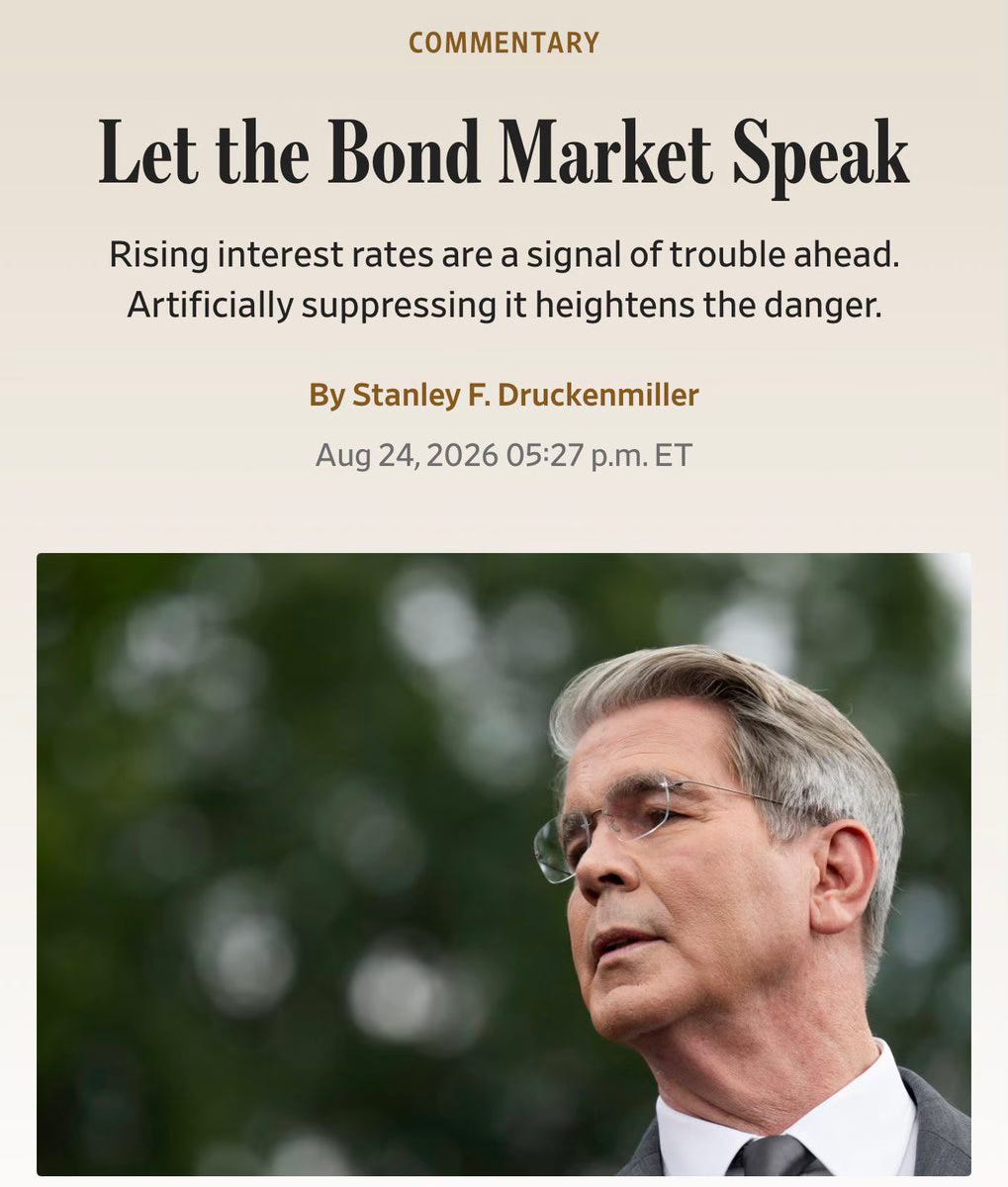
Druckenmiller’s argument is straightforward. There was no market dysfunction to fix. Auctions were clearing, volatility was contained, trading was orderly. What the market was doing was pricing risk: inflation above target, deficits running near 6% of GDP, debt above $40 trillion, and a war in its sixth month. Higher long-term yields, in his telling, are the last form of fiscal discipline Washington still faces. And lets face it, there is very little fiscal discipline coming out of D.C. these days with our deficit coasting past $40 trillion this month.
Suppress the signal Druckenmiller describes and you don’t solve the problem—you briefly sedate the patient while the fever climbs higher and higher in the body. Worse, buying long-duration bonds funded with short-term bills pulls duration risk out of the market. That’s not liquidity management. That’s quantitative easing with a Treasury letterhead. And once traders believe officials are defending a yield level, they will test it, again and again. It’s the money printer go brrrrrrrrr scenario that moves risk assetes like bitcoin higher and higher


Druckenmiller is not wrong about the mechanics. But I’d argue Druckenmiller is describing the symptom while missing the strategy. And let’s be real, nobody in D.C. has the appetite for fiscal responsibility. I’ve been saying this for months now, but the only tool left in the tool box is keep printing to infinity and hope the economy runs hot enough to offset the massive deficit spending. Do we really believe that fiscal austerity is going to happen on the eve of a midterm election??
Bessent’s Two-Front War
Look at what Bessent did in the span of five days. Wednesday: double the buybacks, yields crater on the announcement. Monday: stand at a Treasury podium and declare “Operation Economic Outcast”—an “economic D-Day” aimed at severing every economic lifeline sustaining Tehran, with secondary sanctions threatened against any country that keeps trading with Iran.
These look like separate stories, but they’re the same story. The Iran war is why energy costs are elevated, why inflation won’t come home, and why the long end of the curve keeps selling off. The buybacks are a bridge—a way to hold borrowing costs down while the sanctions campaign tries to force an endgame in the Gulf. Bessent is buying time on one front to win on the other.
And here’s the detail that should worry the White House: while crude itself has actually leveled off, with WTI settling in the mid-$80s and Brent hovering near $88—elevated, the price at the pump hasn’t. The national average for regular hit $4.10 last week, putting August on pace to be the most expensive on record. Diesel is sitting around $5.40, at record seasonal highs, with diesel futures now trading roughly $100 a barrel above crude—a spread that screams refining capacity shortage, not crude scarcity. The war broke the link between the barrel and the pump, and no buyback operation fixes a refinery. Households are paying the war tax every time they fill up, and they’ll probably still be paying after the November midterm elections.


The problem, as Druckenmiller and others see it, is that bridges built on short-term bills have a way of becoming permanent. Strategists were blunt after the announcement: yields drifted right back up within a day, because buybacks don’t fix fundamentals. The market absorbed the signal and started probing for the pain point.
Crypto Already Voted
If you want proof that markets read the buyback as easing, whatever Treasury’s official “liquidity support” framing says, look at what happened to crypto. Within hours of the August 19 announcement, Bitcoin ripped from roughly $64,000 to nearly $70,000, liquidating some $3 billion in short positions in the largest squeeze since 2021. By Friday it had topped $77,000—the strongest week for digital assets in more than two years, with Ethereum up double digits and the majors following. And yesterday, Bitcoin kissed $80,000, trading just under that level at highs not seen since May, capping its biggest three-day rally since 2023.


The mechanism is old and reliable: suppress long-end yields, weaken the competition from “risk-free” paper, and liquidity flows down the risk curve. Bond traders can debate whether Treasury-funded duration removal technically counts as QE. Crypto didn’t debate. It traded it as QE on contact.
And note the calendar. The expanded buybacks run September 9 through November 4. The midterms are November 3. A program that mechanically supports asset prices, timed to run flat-out into Election Day and expire the morning after, is either a remarkable coincidence or exactly what it looks like. Liquidity drives markets higher, and rising markets are incumbent-friendly—which matters double when the same voters are staring at record August pump prices. Druckenmiller’s observation that no market dysfunction forced this intervention lands harder once you see what the intervention was actually synchronized with.
Where the Bessent Doctrine Comes In
Readers of this newsletter know my thesis. The dollar’s first act was Bretton Woods. The second was the petrodollar: the world needed oil, so the world needed dollars, and Gulf surpluses recycled into Treasuries. That loop is leaking — de-dollarization, yuan-priced barrels, central banks diversifying after watching Russia’s reserves get frozen.

The third act is the digital dollar, and the GENIUS Act is its founding charter. Every regulated stablecoin must be backed one-to-one with cash and short-dated Treasuries. Global demand for digital dollars becomes a standing, structural bid for U.S. government debt—replacing the declining sovereign bid with a market-driven one. Bessent has projected a $2–3 trillion stablecoin market by decade’s end. That’s the new recycling loop, written into law.
This is what I call the Bessent Doctrine: extend the old system’s life just long enough to get the new one operational. Kissinger did it in 1973–74. Bessent is running the same playbook—buybacks and sanctions are the holding action; stablecoin-driven Treasury demand is the replacement anchor.
Can He Pull It Off?
Here’s the honest tension. The stablecoin bid is real but concentrated at the short end—bills, not bonds. The stress Druckenmiller is pointing at is at the long end. The third act solves the financing problem over years, butthe bond market votes every day, and that daily moving rate drives the financial news cycle.
What Bessent needs is a bridge to hold off the bond markets until tokenized finance can scale and generate global demand for treasury assets.
If he’s right, the transition looks seamless in hindsight—the way the petrodollar did. If he’s wrong, the failure modes compound: the market calls the buyback bluff, yields rip through the defended level, the fiscal signal Druckenmiller wants preserved returns all at once instead of gradually, and the digital dollar launches into a Treasury market in crisis rather than one it can quietly absorb. Stablecoins backed by the debt of a government losing control of its own curve is not the third act anyone wants.
The doctrine is coherent. The timing is the trade. And right now, the most respected macro trader alive just told you he’s fading it.
The Stablecoin Strategist delivers enforcement-focused intelligence on stablecoin regulation for operators, counsel, and institutions navigating the GENIUS Act cycle. This is analysis, not legal advice; no attorney-client relationship is formed by reading it.