

I spent the better part of this weekend trying to understand what Kraken is actually building with Ink. Here’s where I landed.
Back in July of 2205, Kraken announced it would integrate the Ink L2 protocol into its core products.
We’re excited to announce plans to introduce the $INK token and Ink Layer 2 into our existing product suite, unlocking a new wave of use cases powered by onchain protocols and infrastructure. We aim to deliver seamless onchain experiences and new opportunities for our global client base.
$INK will be issued by a subsidiary of the Ink Foundation, an independent entity that stewards the Ink Layer 2 and its ecosystem.
The token is designed to unify users, protocols and builders across the Ink Layer 2 ecosystem. $INK tokens will be part of Kraken Drops program, and will be airdropped to eligible, active Kraken clients and ecosystem participants.
At first glance the Kraken announcement appears to be their attempt to compete against what Robinhood and Coinbase have built. Yes, but Kraken’s differentiation feels sharper because Kraken is treating Ink less like a general-purpose social chain (not BASE) and more like an onchain financial marketplace (more like Hood).
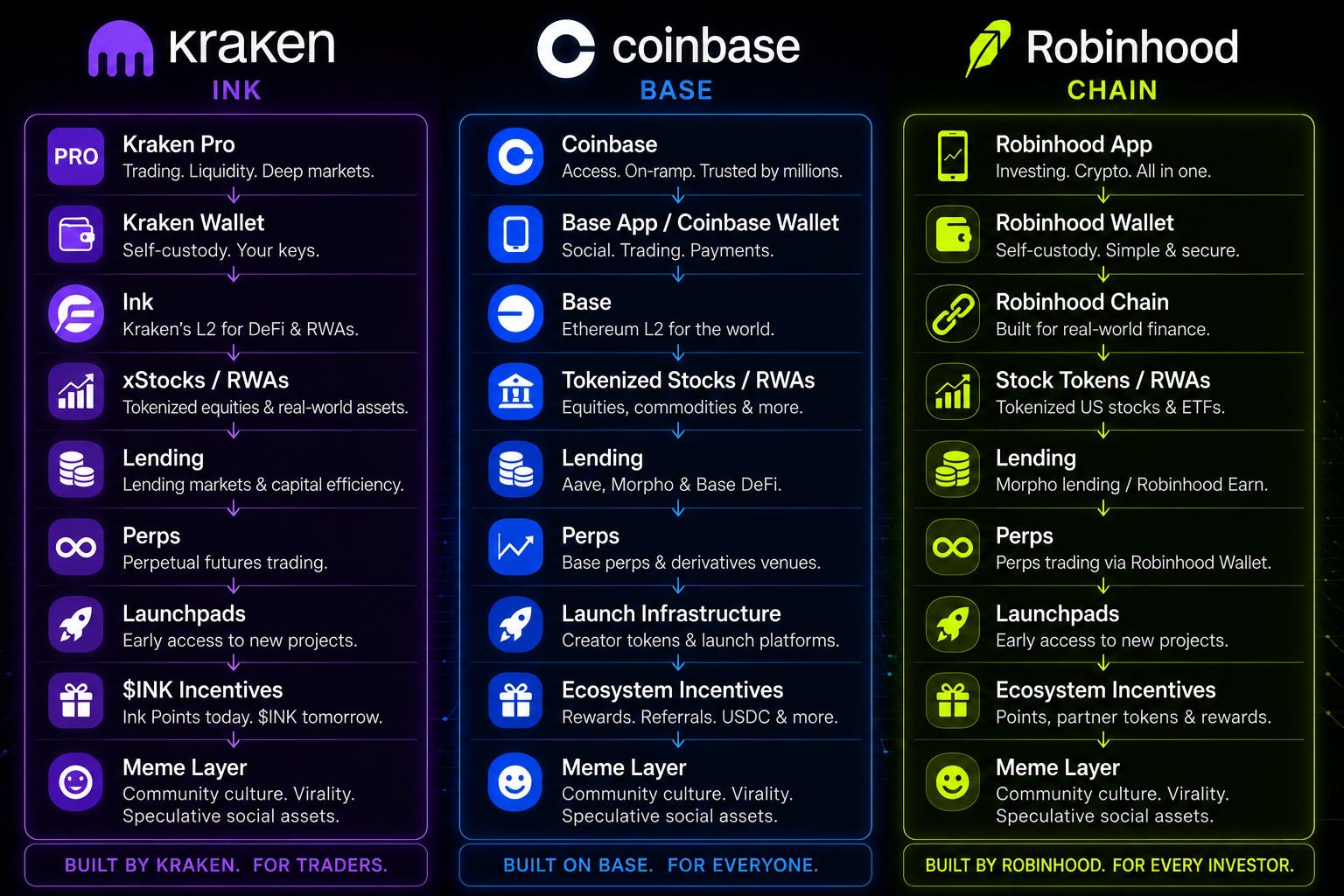
Here is how they stack up:
Robinhood
Robinhood’s chain is designed for tokenized RWAs and for developers to build trading, lending and perpetual-futures products. Its Stock Tokens are ERC-20s designed to be composable—meaning they can become collateral or building blocks in DeFi rather than simply sitting in a brokerage account. Robinhood connected all this to the consumer layer. It launched Robinhood Earn, powered by Morpho, directly inside its app, and added perpetual futures.
Think: Robinhood App → Robinhood Wallet → Robinhood Chain → Stock Tokens / RWAs → Morpho lending / Earn → Lighter perps → $PONS / native launchpads → points / ecosystem incentives → Hood memes/NFTs → native assets.
Robinhood starts with an enormous conventional-retail audience and is pulling them toward crypto/onchain finance.
Coinbase
Coinbase first went in the direction of a consumer/social app. The Base App is essentially their “everything app” combining social, trading, payments, discovery and earning, over its social app.
Coinbase has also now launched native tokenized stocks, including Apple and NVIDIA exposure, backed 1:1 by shares held with a regulated custodian. Coinbase specifically describes them as assets that can be held in self-custody, traded on Aerodrome and used across Base DeFi.
Think: Coinbase → Base App / Coinbase Wallet → Base → tokenized stocks / RWAs / USDC rails → Aave / Morpho lending → Base perps venues → Zora / creator-token / launch infrastructure → Coinbase / Base rewards and ecosystem incentives → BASE memes/Base NFTs → native assets.
Coinbase starts with a huge crypto audience, but increasingly emphasizes consumer/social/tokenized-everything experiences through Base.
Kraken
Kraken feels different because it’s not just building an L2—it’s connecting a deeply crypto-native trading audience directly to Ink, DeFi, xStocks/RWAs, lending, perps, launchpads and eventually $INK incentives.
Think: Kraken Pro → Kraken Wallet → Ink → xStocks/RWAs → lending → perps → launchpads → $INK incentives → INK memes/INK NFTs → native assets.
Robinhood Chain currently has no announced native network token. Coinbase still says it does not currently plan to issue a Base network token. By contrast, Ink has a forthcoming native-token incentive layer in their roadmap.
Kraken therefore feels less like an exchange adding a blockchain and more like its building a total financial ecosystem onchain.
The question nobody is asking
Here is the question I ask about every emerging financial network, and it’s the one that matters for this newsletter:
What money does the economy use?
ETH pays for gas on Ink. Kraken, as the chain’s sequencer, earns revenue from ordering transactions. The INK token therefore will subsidize activity. But when a trader on Ink measures profit, posts margin, pays a fee, provides liquidity or settles a trade, they are not doing it in ETH. And they are not doing it in INK. They are doing it in a stablecoin. On Ink, that stablecoin is USDT0.
USDT0 is not USDT
In January 2025, Tether chose Ink for the very first deployment of USDT0. USDT0 is Tether’s omnichain version of its dollar. It’s built on LayerZero’s Omnichain Fungible Token standard, and every USDT0 minted on a destination chain is backed 1:1 by USDT locked on Ethereum.
That means that a USDT0 balance on Ink is not a Tether-issued USDT balance on Ink. It is a claim on USDT sitting in a contract on Ethereum, transmitted across chains by LayerZero messaging. By opting for this stablecoin collaberation, Kraken made the on-ramp invisible. To move USDT to Ink, a Kraken user simply selects USDT and withdraws on the Ink network. What arrives is USDT0, but most users will never notice the difference. I noticed. And I think it's one of the most important design decision in the ecosystem.
USDT0 is already Ink’s operating currency
Look at Nado, the trading engine at the center of Ink’s economy. Nado is a central-limit-order-book DEX built by ex-Kraken engineers, combining spot, perps and margin lending in one account. USDT0 is the quote asset. It’s the margin asset. Nado’s liquidity vault takes USDT0 from LPs and routes it into market-making and liquidation strategies. And as of August 3, Nado is paying up to $100,000 per week in USDT0 to traders.
Then look at Tydro, Ink’s lending layer, a white-label instance of Aave v3. Its launch markets included USDT0, USDG (the Global Dollar, where Kraken is a consortium member) and Aave’s GHO. And in January, Kraken plugged its own retail customers straight in: Kraken DeFi Earn lets users earn yield on USDC, powered behind the scenes by Tydro, and has already drawn more than $200 million in onchain deposits.
There are three stablecoin plays going on here. Ink’s trading economy runs on USDT0. Kraken’s own yield product runs on USDC. And, Kraken has a stake in USDG. Three dollars, three issuers, one chain.
Why this is the thing to watch
The INK token, when it drops, will pour incentives into all of this. Capital will arrive. Most of it will arrive as stablecoins, and the mix it arrives in will tell us more about Ink’s future than any TVL chart.
If USDT0 stays dominant, Ink becomes the most Tether-centric exchange chain in the U.S. market. If USDC gains share through Kraken’s Earn products, Ink starts to look more like Base. If USDG grows, Kraken is building its own dollar rail underneath its own chain. Each of those outcomes has very different implications for institutions, for compliance teams, and for how the U.S. regulatory framework treats activity on Ink under the GENIUS Act. I’ll get to those questions in future articles. Not today.
If you’re building on Ink, working at the Ink Foundation, or sitting at Kraken thinking about where institutional capital goes next, I’d like to hear from you.
Disclosure: I hold assets in the Ink ecosystem. Nothing here is investment advice.
The Stablecoin Strategist is regulatory and market intelligence for the people building on and deploying capital into stablecoin infrastructure. Subscribe to follow the Ink dollar layer as it develops.
Choosing the settlement dollar is the real product decision and it's almost never reversible — you can fork a chain, you can't quietly swap what the balances are denominated in. Everyone watches token launches because that part is legible.
I use the Flare Network extensively. USDT0 has been the go to stable since my involvement. I convert my USD into USDT0 via Kraken, then send it out.