

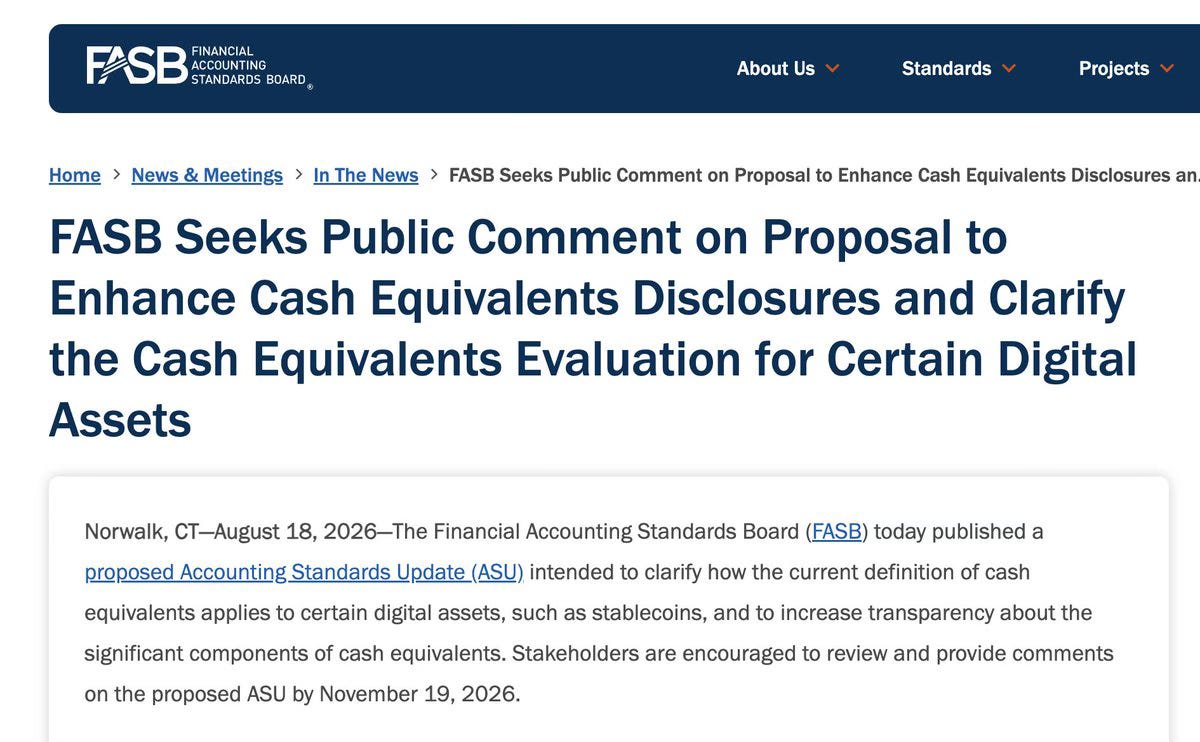
On August 18, FASB published a proposed Accounting Standards Update clarifying when a dollar-pegged token meets the existing definition of cash equivalents. The definition itself doesn't change. What changes is that FASB now offers illustrative examples showing when a stablecoin sits alongside Treasuries, commercial paper, and money market funds on the balance sheet.

The proposed FASB bar is high, deliberately. A qualifying token needs an on-demand contractual redemption right directly with the issuer for a known cash amount, and segregated reserves of at least 1:1 in short-term, highly liquid assets. Deep secondary-market liquidity alone doesn't qualify you. Comments close November 19, 2026.
Here’s why this is the most consequential stablecoin story of the year, and why almost everyone is underrating it.
The moat banks have been digging against stablecoins was never really regulatory—GENIUS settled most of that. It was categorical. A corporate treasurer couldn’t classify a stablecoin as cash. It landed outside the liquidity stack, in a bucket requiring exception memos, extra disclosure, and audit friction. Every dollar of stablecoin exposure had to be defended. Every dollar of bank deposit did not. That asymmetry was the moat, and it was doing more work than any lobbying effort.
SightBringer (@The_Prophet on X) captured the mechanism better than anyone I’ve read on it. His framing: this is about whether digital dollars stop being a crypto product and become part of the definition of money inside corporate finance. Once a qualifying stablecoin can be evaluated against the same functional question as cash and short-duration liquidity, it stops competing for a niche allocation and starts competing for cash-management share. As The_Prophet puts it: ”Corporate finance runs on categories.” Change the category and you change the addressable market. A company never has to become crypto-native—it only has to decide a particular digital dollar is an acceptable liquidity instrument.
That’s the unlock that if approved by FASB, blows open the moat banks have built to guard against stablecoins.
The Stablecoin Strategist delivers enforcement-focused intelligence on stablecoin regulation for operators, counsel, and institutions navigating the GENIUS Act cycle. This is analysis, not legal advice; no attorney-client relationship is formed by reading it.
This is huge
Accounting classification does more work here than regulation does. Once a treasurer can hold something without it landing in a weird bucket on the balance sheet, the internal argument gets a lot shorter.